

Armand Peugeot and Morgat
From northern Franche-Comté to the tip of Brittany
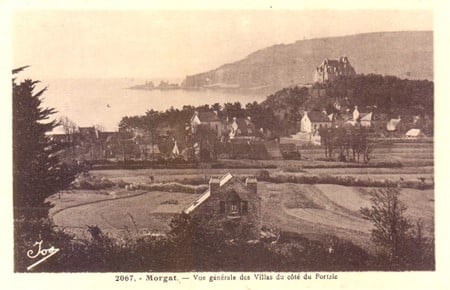
During his military service in Brest in the early 1880s, a young man from Montbéliard discovered the Crozon Peninsula (Finistère, south of Brest) while on leave, as well as the charming little sardine-fishing port of Morgat, sheltered within its bay. He was captivated by the village, its cliffs, its sea caves (already praised by Flaubert), and its beautiful sandy beach bordered by largely untouched land, mostly covered with heath and free of any buildings.
Upon returning home, he shared his discovery with his friend Louis Richard, a travelling salesman from Belfort and a distant relative of Léonie Peugeot, wife of Armand Peugeot.
In 1883, Richard travelled to Morgat, combining sightseeing with his business selling watches and caps. Enchanted in turn by the beauty of the site, he saw its potential as a holiday and seaside resort destination. Upon returning, he told Armand Peugeot about it. Those who knew Armand were aware that he had “an enthusiastic character, loved nature, and was a visionary builder who looked far into the future.”
The two men immediately set off on the long journey themselves: 16 hours by train from Montbéliard to Brest, followed by an overnight stay in Brest. The next day, they boarded a steamship providing service between Brest and Châteaulin, travelling along the Aulne River. They landed at the small port of Le Fret on the Crozon Peninsula and continued by horse-drawn carriage to Morgat, 8 kilometres away.
Armand was equally captivated by what he described as “this wild and magnificent landscape” and decided to create a seaside resort there.
The two men from Franche-Comté stayed several days, lodging at the Hôtel Hervé, the only hotel in the area at the time. To acquire the first plots of land, Armand contacted Maître Pelliet, a notary in Crozon, later succeeded by Maître Kerven.
On 5 January 1884, the company Louis Richard & Co. was established in Montbéliard. Although chaired by Richard, it was initiated and chiefly financed by Armand Peugeot, alongside family members including Eugène II Peugeot and his brother-in-law Louis Fallot. The company later evolved into a civil real-estate company in 1910 under the presidency of Charles Breitling, Armand’s eldest son-in-law and a magistrate.
The company purchased additional land and, with the assistance of Brest architects Abel Chabal and his son Gaston Chabal, built its first hotel, a grocery store, and numerous villas. The first villa constructed for Armand was Villa Bellevue, located on Avenue de la Mer.
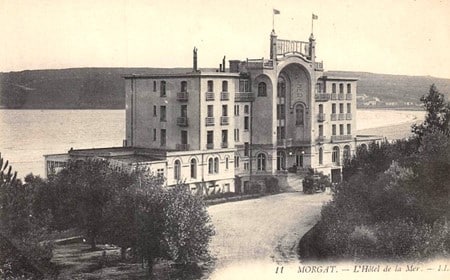
Richard was entrusted with creating the Hôtel de la Mer in 1884, which he managed until the end of 1895. However, Armand criticized the establishment for not offering a direct sea view and for being too far from the shoreline, despite being only about 400 metres away. The hotel later became an annex to the prestigious Grand Hôtel de la Mer, commissioned by Armand Peugeot and designed by Gaston Chabal in 1908 literally “at the water’s edge,” with the customs officers’ coastal path passing directly across its terrace. Construction was completed in June 1912.
When Richard left the company, his shares were purchased by members of the Kreiss family, including Armand Peugeot’s son-in-law, husband of his daughter Germaine. The Grand Hôtel de la Mer, long managed by the Péchin family, is now owned by Atream and the Belambra Group.
Its lobby features the Armand Peugeot Lounge, which displays excerpts from memoirs written by Germaine Kreiss, Armand’s third daughter. Published in 1966 in Les Cahiers de l’Iroise, these writings recount the creation of Morgat, journeys first by train and later by automobile from 1905 onward, and family holidays spent there. In 1974, Raymond Breitling, one of Armand’s grandsons, also highlighted his grandfather’s efforts “to create a seaside resort rather than carry out a profit-driven real-estate venture.”
A testimony to the Belle Époque, the Grand Hôtel de la Mer underwent numerous transformations over time. Through successive extensions, its capacity increased from 20 to 68 rooms. It also required repairs following damage caused by Allied bombing raids in September 1944, intended to target the naval air base located approximately six kilometres away.
Several family residences were also damaged during these raids, and some were destroyed, including Armand Peugeot’s newer residence, Ker Gan Avel (built in 1906). It was rebuilt in 1956 by Gaston Chabal and remained within the Breitling branch of the family. It stands at the corner of Boulevard de la Mer and Avenue Armand Peugeot.
Following the construction of villas for Armand’s relatives, hotels and additional villas were gradually developed by other owners in accordance with the planning rules established by the Chabals, shaping the Morgat we know today.
On land purchased from Louis Richard & Co. by Mr. Desmaret, a Parisian friend of Armand Peugeot, the remarkable “Iron House” was built in 1889. Listed as a Historic Monument, it is one of only two surviving houses of its type in France, the other being located in Poissy.
Some descendants of Armand Peugeot may still own holiday homes in Morgat, although none bears the Peugeot surname today, as Armand’s only son died before reaching the age of thirteen.
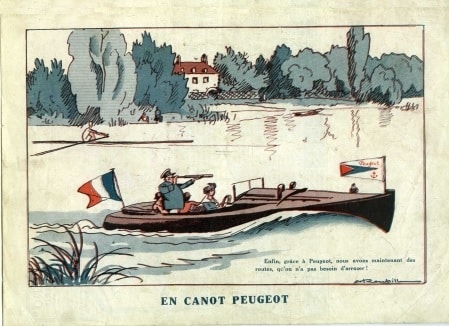
Armand Peugeot was not only the builder of Morgat; he also pioneered the motorisation of local fishing boats. To achieve this, he joined forces with Tony Huber, a small engine and automobile manufacturer based in Billancourt-sur-Seine, and together they founded Armand Peugeot–Tony Huber & Co. on 26 November 1904.
The company’s primary purpose was the manufacture of marine engines. One four-cylinder engine from this range is now preserved in the collections of the Musée de L’Aventure Peugeot. Built at Morgat harbour, the first motorised fishing boat, which still retained its sails, was named Le Comtois. It was also used to take tourists on excursions to discover the peninsula’s spectacular sea caves.
Armand Peugeot also undertook another maritime venture in Morgat by equipping a tuna fishing vessel named L’A-raok. Unfortunately, it sank after only two voyages.
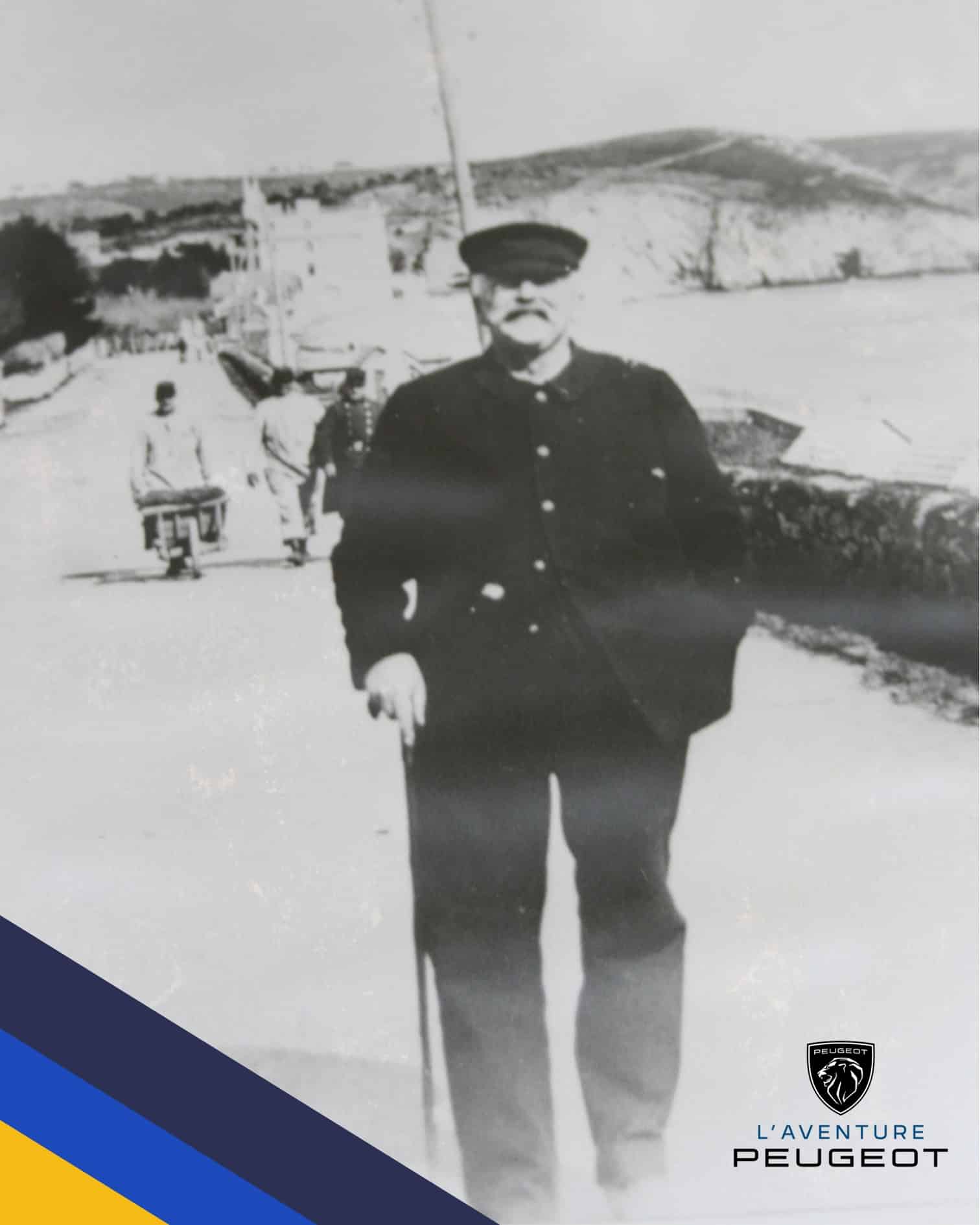
When Armand Peugeot died on 4 February 1915, he had enjoyed little retirement in Morgat, having only retired in June 1913. He nevertheless left behind a small collection of photographs that he had personally taken.
Today, this charming seaside destination is still presented in local tourism brochures as “the seaside resort built by the industrialist Armand Peugeot.”
Henri AUGER, for L’Aventure Peugeot – 26/01/2026